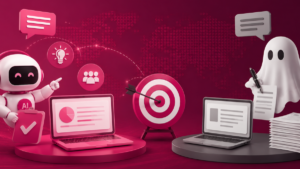
Artificial Intelligence (AI) has rapidly become a valuable ally for communication professionals. From drafting e-mails and press releases to analyzing social media sentiment and summarizing reports to even generating images and videos, AI tools can significantly streamline day-to-day tasks, saving both time and cognitive energy. However, while these tools offer immense benefits, it’s crucial to use them responsibly and critically.
Time-saving and efficiency gains
One of AI’s most celebrated strengths lies in its ability to accelerate content creation. Generative AI tools can:
- Draft e-mails, blog posts, and speeches based on prompts.
- Summarize long articles or documents.
- Organize and categorize large volumes of information.
- Generate content ideas or outlines tailored to specific audiences (social media posts, presentations, website articles, infographics and more…).
These functions enable communication managers to focus more on strategy, creativity and human engagement—areas where AI still falls short.
A note of caution: verify and review
Despite their utility, AI tools are not infallible.
They may:
- Misinterpret context or tone.
- Provide outdated or fabricated information.
- Overuse vague or generic language.
Therefore, professionals must always fact-check the information AI provides. Reading through AI-generated content and ensuring it aligns with brand voice, cultural context and factual accuracy is essential.
Common overused words by AI
AI tools tend to rely on a set of commonly used, sometimes overly polished, words. Here are examples that may signal a need for human editing:
- Leverage
- Utilize
- Empower
- Synergy
- Revolutionary
- Seamless
- Innovative
- Robust
- Transformative
- Cutting-edge
- Dive in
- Unlock
Replacing or refining these words can make communication feel more authentic and less like it came from a template.
Best practices for communication managers
To make the most of AI while maintaining ethical and effective communication, consider these additional tips:
- Use AI for first drafts, not final ones. Think of it as a collaborator that needs supervision.
- Avoid feeding sensitive or confidential data into AI tools, especially if they are cloud-based or unclear about data storage policies.
- Train your team on prompt engineering—how to write effective prompts for better outputs.
- Establish a quality control process for reviewing AI-generated content.
- Monitor tone and inclusivity. AI might reinforce biases if left unchecked.
- Use AI for audience analysis—many tools can identify trends or sentiments across platforms, helping tailor messaging effectively.
AI is a powerful assistant, not a replacement for critical thinking or human judgment. In communication, where nuance, credibility, and trust are vital, the human touch remains irreplaceable. By embracing AI thoughtfully and ethically, professionals can enhance their workflows while maintaining the integrity and effectiveness of their messages.