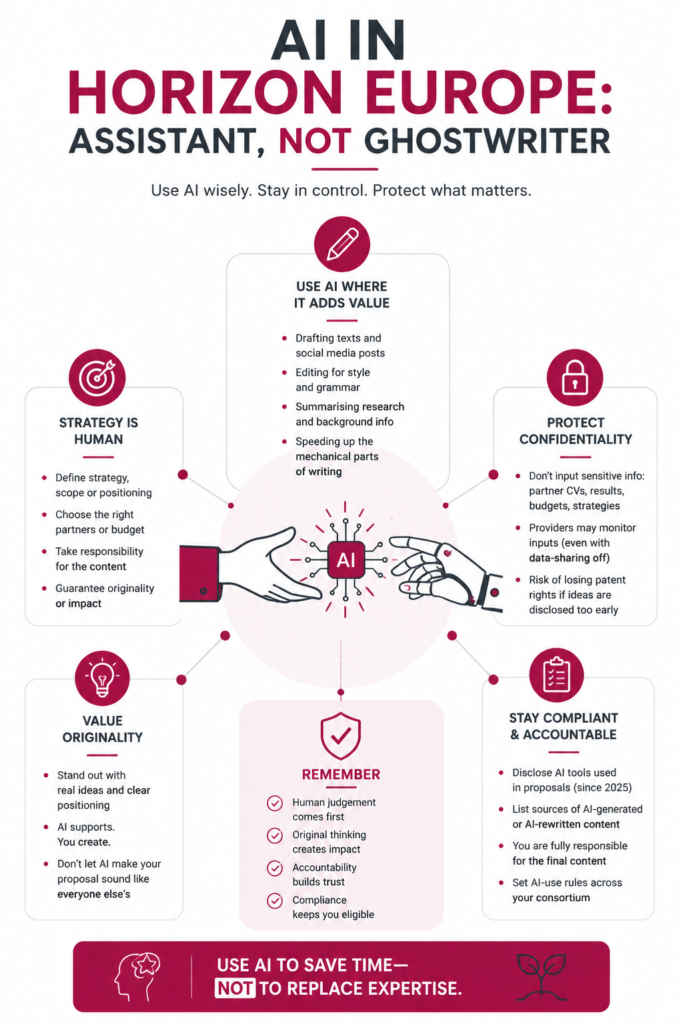
AI in Horizon Europe should serve as an assistant, not a ghostwriter

Explore how to use AI responsibly in Horizon Europe proposals and projects—boost efficiency while protecting confidentiality, originality, and compliance.

Artificial intelligence has become part of daily life for most people working in EU project communication and proposal writing, and I am no exception. I use AI tools frequently, both for work and privately, and the more I use them, the more convinced I am that the real skill is not knowing how to prompt a model, but knowing where to draw the line.

The standard use case: content, not strategy

For most people in this field, AI has settled into a fairly predictable role. It drafts texts, writes social media posts, edits for style and grammar, and speeds up research. This is the low-risk, high-value use case, and it is where AI genuinely earns its place in a daily workflow.

Some people go a step further and use AI for proposal writing itself. A whole ecosystem of tools now promises exactly that: prompt-based systems, “AI proposal builders,” and consultancies offering AI-assisted drafting aligned with Horizon Europe’s Excellence, Impact, and Implementation structure. I have seen several of these tools presented at events, and I remain sceptical of them, though not entirely dismissive.

What they do well is polish: fixing grammar, tightening structure, summarising background research, and speeding up the mechanical parts of writing. What worries me is when polish gets mistaken for strategy. A proposal is not just well-written text; it is a set of choices about scope, partners, budget, and positioning that a tool cannot make for you, and it is a document you remain fully accountable for. The European Commission has made this accountability explicit: since 2025, the Horizon Europe Standard Application Form has required applicants to disclose which AI tools they used, list the sources behind AI-generated or AI-rewritten content, and take full responsibility for it. There is no hiding behind “the AI wrote it.”

Confidentiality first, always

This is the point I keep coming back to: be careful what you feed into these tools. Proposals routinely contain information that should never end up in a public AI system – partner CVs, unpublished results, budget breakdowns, consortium strategy, or anything with commercial sensitivity. Even with data-sharing settings switched off, most providers still monitor input for abuse detection, and that monitoring can, in some interpretations, count as a form of disclosure. For anything touching a patentable idea, that is a real risk, not a theoretical one: putting an invention into a public AI tool before filing could undermine your right to patent it later.

The safest rule I follow is simple: if the information would cause a problem should it ever become public, it does not go into an AI tool. Caution is not paranoia here; it is basic professional hygiene, and increasingly a contractual expectation. Coordinators are now encouraged to set AI-use rules across the whole consortium, covering partners, consultants, and work package leads alike, precisely because one person’s careless use of a note-taking bot or a “helpful” chatbot can expose confidential discussions that were never meant to leave the room.

Why imperfection still has value

The more I use AI, the more I believe that some imperfection and creativity are worth more than cold, polished perfection. This is not nostalgia for typos. It is a practical observation: AI tools tend to converge on similar phrasing, similar structures, and similar arguments, because they are trained on similar material. A recent study published in Nature found that heavier use of large language models in proposal writing was consistently linked to lower semantic distinctiveness – in plain terms, AI-assisted proposals start sounding like each other, and like whatever has already been funded. In a system where originality is part of what gets rewarded, that is a real cost, not just a stylistic quibble.

There is also a bigger structural risk on the horizon. Horizon Europe applications have surged by roughly 80% compared to a few years ago, while success rates in some calls have dropped into single digits. Part of that pressure comes from AI making it easier to draft, revise, and resubmit proposals quickly. Faster writing does not mean better ideas; it just means more competition for evaluators to sort through, and less time for reviewers to notice which project is genuinely original.

Staying in control

None of this means AI should be avoided. It saves an enormous amount of time, and refusing to use it is not a realistic option in this profession. But I think we have to sit down in front of these tools deliberately, not passively. We should treat AI as a fast, occasionally brilliant, occasionally wrong assistant, and keep the final decisions, the final wording, and the final validation firmly in our – human hands. Fabricated citations are a well-documented failure mode; research has found hallucination rates in AI-generated references ranging from roughly 14% to 95% depending on the model. In a funding proposal, one invented source can undo weeks of good work.


WIT Berry EU

Beyond drafting: using AI during implementation

Once a project is funded, the most basic use of AI is still content creation – dissemination posts, newsletters, reports. But there is far more available during implementation, provided the use complies with the EU’s AI Act. AI can support the drafting of periodic and technical reports, background research on the state of the art, literature scans, and even simulations or scenario modelling for certain types of work packages.

The caution from the proposal stage carries over here, and in some areas it gets stricter. Anything involving personal data, emotional or behavioural interpretation, or health-related information needs particular care, since these areas sit closer to the higher-risk categories under the AI Act, even when the project itself is not classified as high-risk. The same principle applies throughout: if it would be a problem for that information to become public, it does not belong in a general-purpose AI tool.

One distinction worth keeping in mind is scale. A research and innovation organisation with the resources to develop or fine-tune its own AI model is in a different position entirely. A tool trained, hosted, and controlled internally, under a proper confidentiality agreement, for specific purposes, implementing the specific tasks as a part of the innovation or research is not at the same risk category as a public chatbot, and it opens the door to uses that would otherwise be too sensitive to consider.

At the end…

AI in Horizon Europe work is now standard equipment, not a novelty. Used for drafting, editing, and speeding up research, it is close to indispensable. Used as a shortcut for strategy, judgement, or confidentiality, it becomes a liability. The organisations that get this right will not be the ones using AI the most, but the ones using it the most deliberately – fast where speed helps, cautious where caution is non-negotiable, and always with a human making the final call.