If your business uses ChatGPT, Midjourney, Adobe Firefly, Gemini, or any other AI tool to create content, there’s a new question you need to ask before you hit “Publish.” Does this content need an AI label?
From 2 August, new EU transparency rules require certain AI-generated content to be disclosed. Whether you’re publishing marketing materials, social media posts, videos or news content, understanding when a label is required is now part of staying compliant.
While AI offers incredible opportunities, it also brings new challenges. Deepfakes, manipulated images, synthetic voices, and AI-written content can easily mislead people if they are presented as authentic. Transparency has therefore become more important than ever. And here we don’t talk only about the social media but all type of content.
To address these concerns, the European Union’s AI Act introduces new transparency obligations that apply from 2 August 2026. The goal is simple: people should know when they are interacting with AI or consuming AI-generated content that could be mistaken for something real.
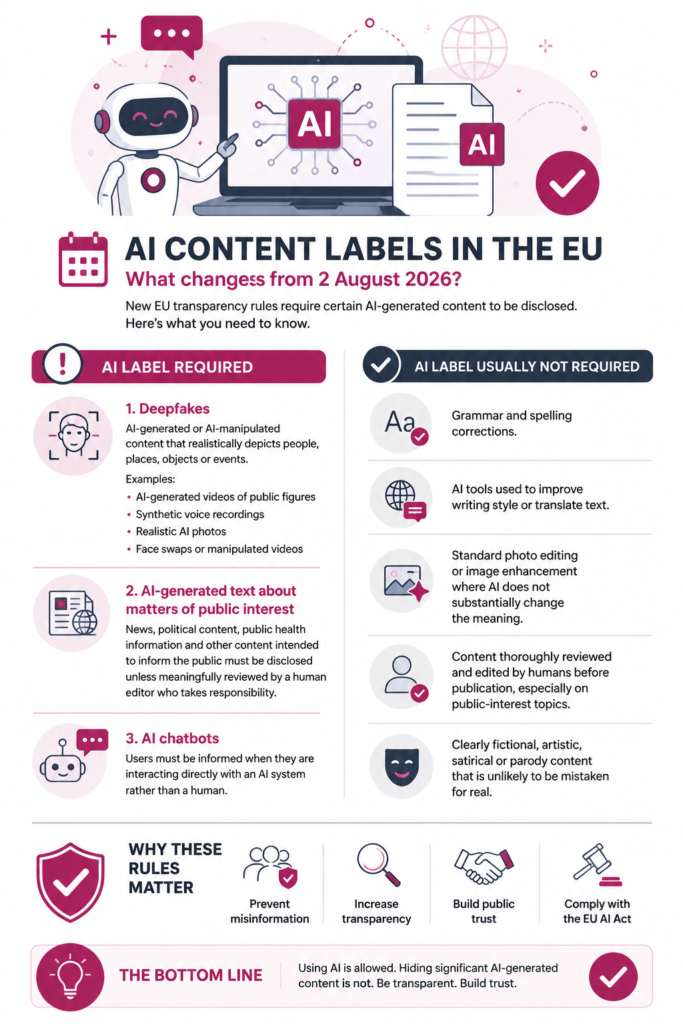
What AI-generated content needs to be labelled?
Under the new rules, AI-generated or AI-manipulated content must be disclosed in specific situations, including:
01. Deepfakes
Any AI-generated or AI-manipulated image, video, or audio that realistically depicts a person, object, place, or event and could be mistaken for authentic must be clearly labelled as AI-generated or AI-manipulated.
Examples include:
- AI-generated videos of public figures
- Synthetic voice recordings that imitate a real person
- Realistic AI photos that appear to show actual events
- Face swaps or manipulated videos designed to look genuine
02. AI-generated text about matters of public interest
If AI creates or substantially manipulates news articles, political content, public health information, or other content intended to inform the public, it must be disclosed unless it has undergone meaningful human editorial review and a person or organisation takes editorial responsibility for the final publication.
03. AI chatbots and virtual assistants
Users must be informed when they are interacting directly with an AI system rather than a human, except where this is already obvious from the context.
What does not need to be labelled?
Not every piece of AI-assisted content requires a visible label. Examples that generally do not require disclosure include:
- Grammar and spelling corrections.
- AI tools used to improve writing style or translate text.
- Standard photo editing or image enhancement where AI does not substantially change the meaning of the content.
- Content that has been thoroughly reviewed and edited by humans before publication, particularly for public-interest text where a human editor assumes responsibility.
- Clearly fictional, artistic, satirical, or parody content, provided people are not likely to mistake it for reality.
Why these rules matter
The new transparency requirements are not intended to discourage the use of AI. Instead, they aim to build trust.
Consumers deserve to know whether a realistic image, video, voice recording, or article was created by a human or by artificial intelligence. Clear labelling helps reduce misinformation, protects against fraud and impersonation, and supports informed decision-making.
For businesses, content creators, marketers, and publishers, the message is straightforward: using AI is perfectly acceptable, but when AI creates or significantly manipulates realistic content, transparency is now part of responsible publishing.
The bottom line
AI is here to stay, and it will continue to reshape how we create and consume content. The EU AI Act marks an important step towards making that future more transparent.
If your organisation uses AI to generate realistic images, videos, audio, or publishes AI-generated information on matters of public interest, now is the time to review your workflows and ensure you are complying with the new transparency rules.
Being transparent isn’t just about meeting legal requirements, it also helps build trust with your audience.