Often your proposal isn’t being rejected for its science. Why? How?
Securing Horizon Europe funding is getting harder. That’s not because the ideas are getting worse. It’s because everyone else’s proposals have got better, or at least better written.
The European Commission’s own interim evaluation puts it plainly. In the programme’s first three years, only the top 16% of applications were funded. Nearly seven out of ten high-quality proposals were rejected purely because there wasn’t enough budget. Funding all of them would have needed an extra €82 billion. The success rate has kept falling since then: roughly 16% in 2023, 14% in 2024, and around 12% in the 2025 calls evaluated so far. The EIC Pathfinder funded 44 proposals out of 2,087. That is 2%.
Read that again: rejected for lack of budget, not for lack of merit. The evaluators liked the proposal. Someone else was just slightly ahead in the queue, with a slightly sharper methodology, a more honest risk assessment or a more credible impact pathway. That’s the real game, and most consortia are still playing the wrong one.
What 13 points actually means
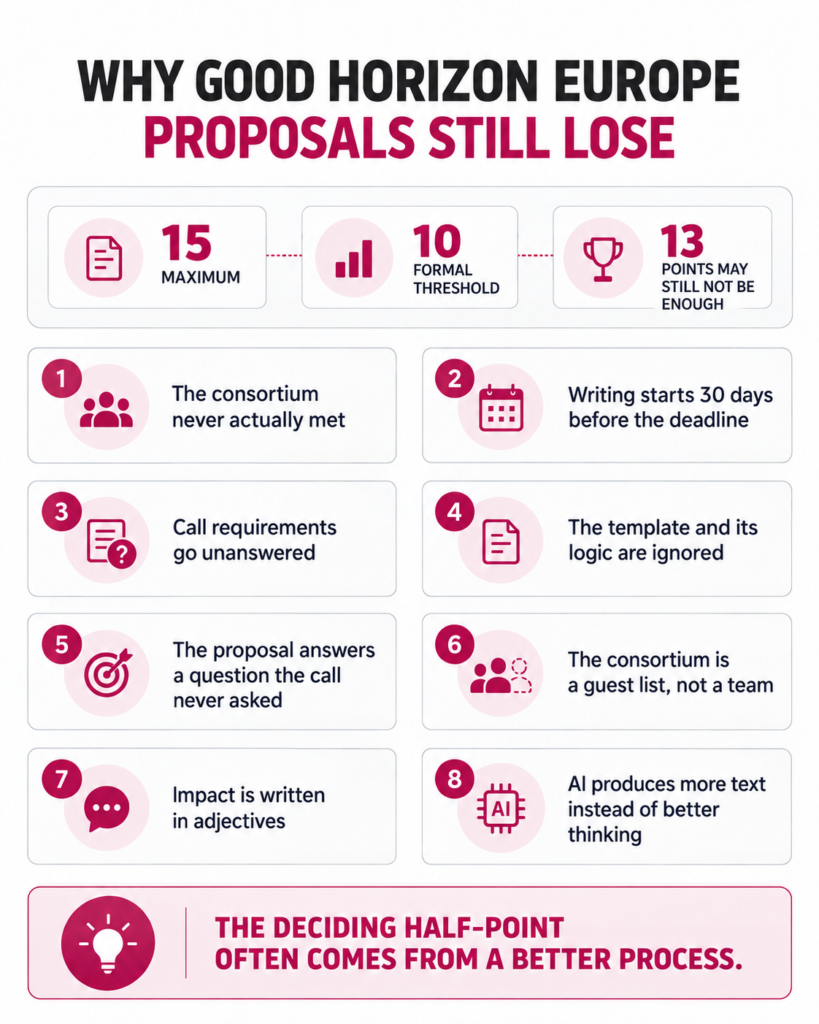
There are three criteria: Excellence, Impact and Implementation. Each is scored from 0 to 5 in half-point steps, so the maximum is 15. The formal threshold is 10 points overall.
The threshold tells you whether a proposal is competent. They don’t tell you whether it will be funded.
Look at the Circular Bio-based Europe JU’s 2024 call. Of 289 fully evaluated proposals, 30 went to grant preparation and another 35 landed on the reserve list. 119 cleared every threshold and still got nothing. 85 proposals scored between 13.5 and 14.5. Clean Hydrogen’s 2024 call tells the same story: 88 proposals passed the threshold, together asking for €440.6 million against a budget of €113.5 million. 19 were funded. More info.
So when I say I can usually tell whether a proposal will clear 13 points, I’m not claiming to judge the science. My claim is less flattering and more useful: better science almost never buys the half-point that decides your outcome. A better process does. And the process leaves fingerprints all over the document.
Here’s what I look for.
01. The consortium never actually met
The coordinator becomes a human API. They request text, receive text, paste text, and send ever more polite reminders. Partners review their own sections and approve them. Nobody builds anything together. You end up with twelve competent contributions and no actual project.
You can see it on the page. Work packages quietly duplicate each other. Two partners solve the same problem in different sections, neither aware of the other. The methodology has never been argued about, which is why it has never been improved.
Strong proposals come out of meetings where people disagree. Someone questions the intervention logic. Someone admits their task is undersized. Someone notices that WP4 depends on a result WP3 delivers three months too late. That friction doesn’t delay the writing. It is the writing.
02. Writing starts 30 days before the deadline
Thirty days is enough to produce a proposal. It isn’t enough to develop one.
This isn’t folklore. CBE JU’s analysis of its 2024 call found that proposals created earlier were more likely to be funded. Its explanation makes sense: early starters have time to strengthen the consortium, fix blocking issues, and meet requirements that late starters only discover at 23:40 on deadline day.
Competitive proposals take months, because most of the useful work is throwing things out. You need time to test the impact pathway and find it hollow. You need time to rebalance person-months once you notice that one partner is doing 40% of the work for 12% of the budget. And you need time to discover that the work-plan diagram only made sense to the person who drew it. A deadline speeds up typing. It doesn’t speed up thinking.
03. The call’s requirements go unanswered
Every topic text is a list of requirements, some stated outright and some buried in a subordinate clause. Evaluators assess how well you address each one. A requirement you skip doesn’t just go unrewarded. It becomes a written shortcoming or even weakness in your Evaluation Summary Report.
And they’re easy to skip, because they hide in plain sight:
- TRL targets: “Activities are expected to start at TRL 4 and achieve TRL 6 by the end of the project.”
- Pilot and demonstration conditions: “at least three pilots in different Member States”, or “demonstration in a real-life operational environment”.
- Mandatory approaches: multi-actor involvement of end users, citizen engagement, or a required contribution from the social sciences and humanities (SSH).
- Cooperation clauses: links to other projects funded under the same topic, to a European Partnership, to a Mission, or to the Joint Research Centre. Sometimes the call even says you should set aside budget for joint activities.
- Policy anchors: named strategies, regulations or initiatives your results are expected to feed into.
- Specific conditions: limits on the EU contribution, consortium composition rules, and eligibility clauses that can end the story before any evaluator reads a word.
The fix isn’t glamorous. Turn the topic text into a compliance matrix. Every “must”, “should”, “is expected to” and “is encouraged to” gets a row, plus the section and page where you address it. If a row stays empty, that’s your next meeting’s agenda.
Remember that evaluators use Ctrl+F too. If the call asks for TRL 6 and a search for “TRL” finds one vague mention on page 31, you’ve told them something about how you work and even if it is somewhere addressed – it might not be sufficiently clear to be confident that you actually know what you plan to do.
04. The proposal ignores the template and its logic
The Part B template isn’t a formality. It mirrors the evaluation form. Each section corresponds to something an evaluator must score, so when you rearrange, merge or skip sections, you’re hiding content from the person looking for it.
There is room to be creative in how you fill the template. Completeness won’t win you funding, but it keeps you above the threshold. A weak risk table can be criticised. A missing one can’t be scored at all.
It still surprises me how often the basics aren’t there:
- Objectives that aren’t objectives. The template asks for objectives that are clear, measurable, realistic and achievable within the project duration. “To advance knowledge of X” is an aspiration. “To validate the prototype in two operational environments, reducing energy use by 20% against the 2025 baseline, by month 30” is an objective.
- TRL named but never pinned down. Stating “TRL 5–7” for the whole project, instead of giving the starting and target level for each technology or component, tells the evaluator you haven’t mapped your own solution.
- KPIs without baselines or targets. An indicator with no starting point and no endpoint measures nothing.
- Milestones without means of verification. “Pilot completed” is a hope. “Pilot report approved by the steering committee” is a milestone.
- Mandatory methodology elements missing. Open science practices, research data management, and the gender dimension in research and innovation content are required elements. They aren’t optional extras for the final week.
- Tables that contradict the text. The Gantt chart says one thing, the work package descriptions another, and the person-month table a third.
None of this need expertise in your technology. All of it needs discipline, and evaluators notice when it’s missing with just a glimpse on your proposal document. Thus, we might say that the process is too bureaucratic, but to evaluate various different proposals there should be a template – to make the rules fair and to allow the team to demonstrate how serious they are in finding solutions, answers and demonstrating precision.
05. The proposal answers a question the call never asked
Some proposals contain excellent ideas, from an excellent consortium, aimed at a topic that exists mostly in the coordinator’s imagination.
Every expected outcome, every scope condition and every policy priority in the call should be traceable through your objectives, activities, results and impact pathway. Doing that tracing is your job, not the evaluator’s. Evaluators are experienced and fair, but they aren’t paid to solve mysteries. If the link between the call’s expected outcome and your WP5 exists only in your head, it doesn’t exist.
This matters more than ever in 2026–2027. The Commission cut the number of topics by around 35% and made the remaining ones less prescriptive. Broader topics mean more proposals per topic and more room for interpretation. That sounds like freedom, but it behaves like a trap.
06. The consortium is a guest list, not a team
A famous institution strengthens a consortium. Its logo doesn’t lead a work package, recruit pilot sites or deliver anything.
The test is quick and brutal: if you removed a partner, what would break? If the honest answer is “the cover page would look less impressive”, the evaluator has already worked that out.
The same test applies to the budget, and this is where proposals most often give themselves away. The narrative promises a technological breakthrough, deep stakeholder engagement and four large-scale pilots. The person-month table suggests it will all happen on alternate Friday afternoons. Or it’s the reverse: 80 person-months for a task described in one sentence.
Your budget is part of your argument, not an annex. When the numbers and the narrative describe different projects, evaluators believe the numbers. This will only get sharper as lump-sum funding expands to around half the call budget in the 2026–2027 work programme. Under a lump sum, the work plan is the financial logic, and there’s no final invoice to rescue a vague task description.
07. Impact is written in adjectives
Impact is too often where the optimistic sentences get stored after the real work has been described. And it shows.
In many of the calls I’ve seen analysed, Impact is the weakest criterion. Part of the problem is structural. The template puts communication, dissemination and exploitation under one heading, so many proposals treat them as one activity with three names. They are three different disciplines, each with its own audience and purpose:
- Communication promotes the project and its results to a broad audience: media, the public, policymakers. Its question is why should society care?
- Dissemination makes the results publicly available to people who can use them, such as researchers, industry, practitioners and standardisation bodies. Its question is who needs to know, and through which channels?
- Exploitation is the actual use of the results: in further research, in products and services, in policy, or in standards. Its question is who will use what, how, and on what terms?
08. AI produces more text instead of better thinking
Let me be precise here, because this topic invites sloppiness in both directions.
I’m not talking about AI writing proposals. I’m talking about AI doing the tasks a tired consortium stops doing properly in week nine, and doing them without ever touching confidential, personal or GDPR-sensitive data.
You can ask it to:
- check whether every expected outcome in the call text can be traced to something in the document
- list every term used inconsistently across sections: demonstrator, pilot and living lab, all apparently the same thing
- find claims made without evidence
- test whether your KPIs are actually measurable
- read the risk table as a sceptic would
- generate the twenty hardest questions an evaluator might ask
Then be honest about which of those questions you can’t answer. That’s where the half-points live.
The trap is the opposite use. Fluent language hides weak logic remarkably well, and better now than ever. AI will happily turn an average paragraph into an impressive one, and an impressive paragraph into three. But a well-written description of an incoherent project is still an incoherent project, just with better rhythm. And once everyone has access to the same fluency, fluency stops setting you apart and becomes the baseline.
The useful question was never “can AI write this section?” It’s this: what is missing, contradictory or unconvincing, and are we brave enough to find out while there’s still time to fix it?
The uncomfortable conclusion
Every sign above is visible weeks or months before submission. None of them requires understanding the technology, science or innovation. All of them are process failures that harden into document failures.
That’s actually good news. You can’t control the budget. You can’t control how many other consortia submit. You can’t control whether a topic attracts 12 proposals or 80. You can control whether your consortium ever sat in a room and argued.